Is PAT Testing a Legal Requirement?
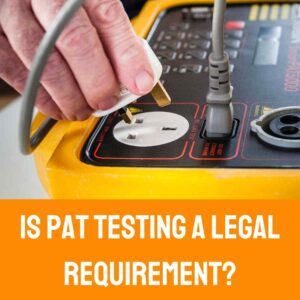
IS PAT Testing a legal requirement? Quick Answer: No
Details Answer: It is advised to PAT Test your premises due to the below:
However, current UK legislation states that businesses or organisations must maintain electrical items in a safe condition.
The business owner or responsible person has legal responsibility to ensure the safety of employees and the public.
Because PAT testing is one of the most effective ways to do this, particularly for high risk or large, complex environments, it has become a standard way of meeting this legal obligation.
It is not a legal requirement to have your place of business or organisation PAT Tested. However as an employer or responsible person you do have a legal responsibility to ensure your organisation is a safe place to visit or to work at. The Government has put measures in place to make sure you make sure regulations are met. The four main regulations that any employer must adhere to are:
Health and Safety at Work Act of 1974
The Health & Safety at work act state it’s responsibility of the business owner to ensure the work equipment ‘is maintained’ in an:
- Efficient state
- In a good working order
- And in good repair
The Electricity at Work Regulations of 1989
The purpose of the Regulations is to require precautions to be taken against the risk of death or personal injury from electricity in work activities.
The HSW Act applies principally to employers, the self-employed and to employees, including certain classes of trainees.
The Management of Health and Safety at Work Regulations of 1999
It is the owner’s responsibility to ensure the health and safety of employees in the business premises.
So it is the employer’s responsibility to ensure safety. The owner has to assess the dangers of the environment the employees and customers might face.
PAT testing is not directed by the law. But it is a legal obligation to carry out a PAT test to meet the safety at work regulations in the UK.
The Provision and Use of Work Equipment Regulations of 1998
These Regulations, often abbreviated to PUWER, place duties on people and companies who own, operate or have control over work equipment. PUWER also places responsibilities on businesses and organisations whose employees use work equipment, whether owned by them or not.
PUWER requires that equipment provided for use at work is:
- suitable for the intended use
- safe for use, maintained in a safe condition and inspected to ensure it is correctly installed and does not subsequently deteriorate
- used only by people who have received adequate information, instruction and training
- accompanied by suitable health and safety measures, such as protective devices and controls. These will normally include emergency stop devices, adequate means of isolation from sources of energy, clearly visible markings and warning devices
- used in accordance with specific requirements, for mobile work equipment and power presses
It has been known that not complying to the above regulations that fines of north of £10, 000 and imprisonment of up to 2 years on some high case examples have been given where the employer has neglected the management of electrical appliances at the workplace.
So as much as it is not true that companies are required by law to have their site PAT Tested – but having PAT testing in place as part of your policies to ensure you are doing everything possible to maintain a safe place to work will go a long way.
PAT testing is the fastest and most efficient way to finding faults that if left and ignored could prove fatal one day. PAT testing is the best way to prevent any accidents at work that could have easily been avoided.
IT is the employer or responsible person’s duty to highlight the dangers of the workplace and to take the relevant steps to ensure their workplace keeps within the Heath & Safety at Work Regulations 1999.
Insurance
Most business insurances do specify PAT Testing to be carried at the correct frequencies out to ensure the insurance cover stays valid. To find out the frequency when your appliances should be tested and find out here.
Insurances require items to be PAT testing as it isn’t uncommon for faulty equipment to cause a fire when unattended or worse, injury to a staff member or the public. PAT Testing is the easiest and most cost effective way of showing your organisation has taken steps to avoid anything untoward.